The Enterprise Intelligence Platform
Frontier intelligence,
owned by the enterprise.
SuperBrains consolidates enterprise data, institutional knowledge and agent workflows into an intelligence layer the organisation owns. Because that layer resolves the context, smaller models deliver frontier-quality outcomes at materially lower cost per answer.


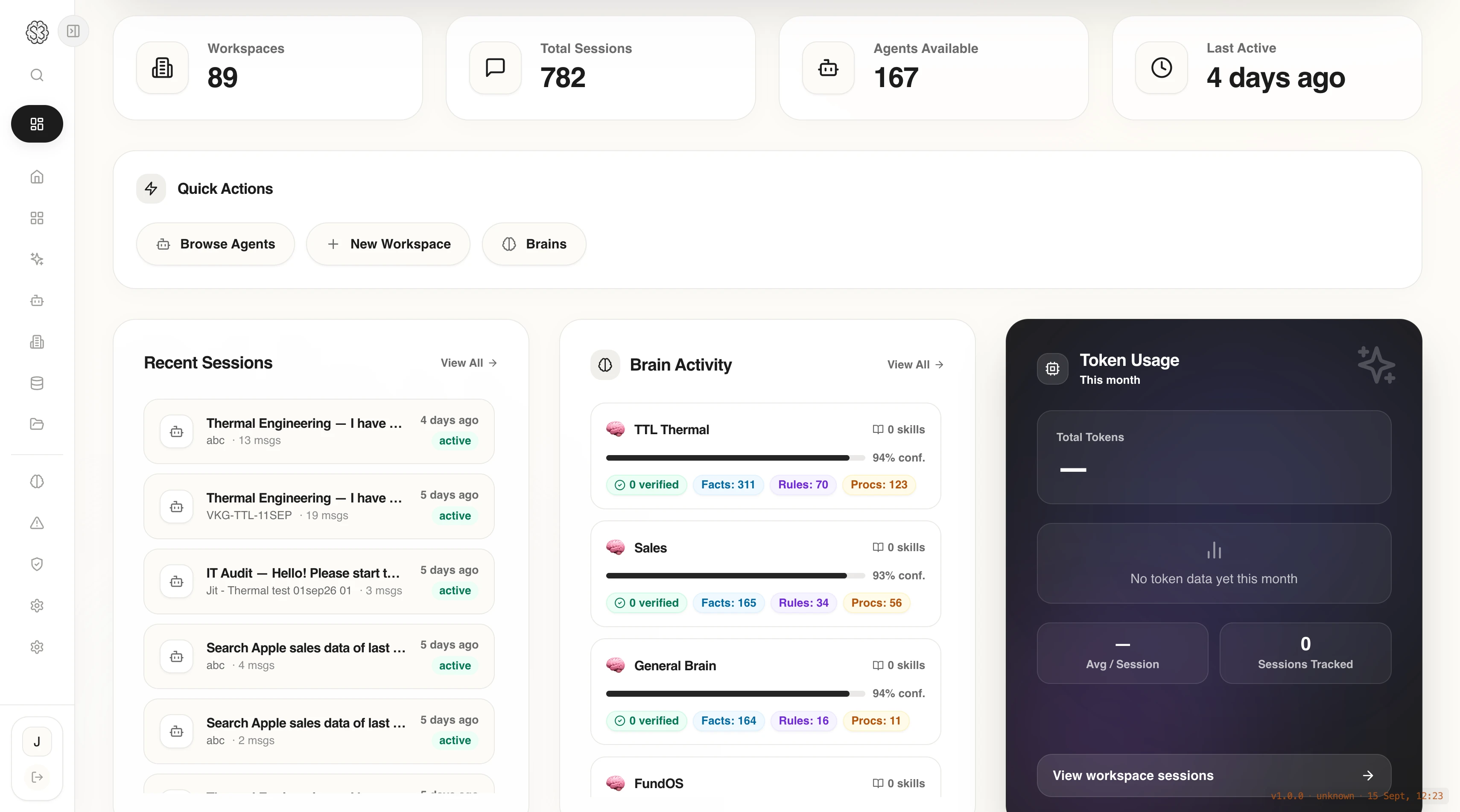
Connects to the enterprise systems the intelligence layer draws on
- Google Drive

- Gmail

- Notion

- Confluence

- Jira

- GitHub

- HubSpot

- Zendesk

The Problem
AI spend compounds.
Enterprise intelligence does not.
Most enterprises are not failing at AI. They are operating it without owning any part of it.
Each query is regenerated from nothing. Each answer is paid for again. A general model is asked to rediscover context the business already holds, because no prior work is carried forward. The result is an operating cost that rises each month against a capability that does not advance. The constraint is architectural rather than technological: there is no layer beneath the model that retains and compounds what the business already knows.
5–30×
Agentic workloads consume 5 to 30 times more tokens per task.
Company intelligence is fragmented
The knowledge behind good decisions lives across documents, databases, tools, chats and systems, and often inside the heads of experienced staff. Agents cannot read it as one connected business context.
Context leaves with people
Decisions, approvals, client details, exceptions and recurring patterns are rarely captured as reusable memory. When people leave or change roles, that context goes with them.
Expertise does not convert into capability
SOPs, workflows, judgement and expert processes remain dependent on individuals rather than becoming reusable skills that teams and agents can apply consistently.
The Category
Frontier models hold general intelligence.
Enterprises need institutional intelligence.
A frontier model arrives with broad capability and no knowledge of your enterprise. The intelligence layer supplies what it cannot know: your context, your rules, and the decisions already made.
What frontier intelligence meansBuilt from work, not only from documents
The intelligence layer is shaped by how teams and agents work, not only by what is recorded in documents. It accumulates with use, and it remains the property of the enterprise.
Cost per answer falls as the layer matures
Three mechanisms reduce cost: work resolved inside the intelligence layer, workload-based model routing, and computation executed as code rather than inferred. As the layer matures, less is asked of the model on each call.
Governed from the first deployment
Security, governance and data sovereignty controls are embedded at every layer, so adoption proceeds within the enterprise's existing compliance obligations rather than alongside them.
The Architecture
Five layers.
The enterprise owns the fourth.
Most AI stacks stop at orchestration. SuperBrains adds the layer above it, and that layer is the one the enterprise owns.
05
Security, Governance & Observability
04
Company Intelligence Layer
03
Orchestration & Agent Studio
02
Model & Control Plane
01
Enterprise Data Layer
The Product
Six surfaces,
one intelligence layer.
Agent Studio, Workflow Studio, Applications Hub, Neuro Ports, Artifacts and Governance. Each is a working surface for a different team, and all six draw on the same intelligence layer.
Implementation
How SuperBrains
is implemented
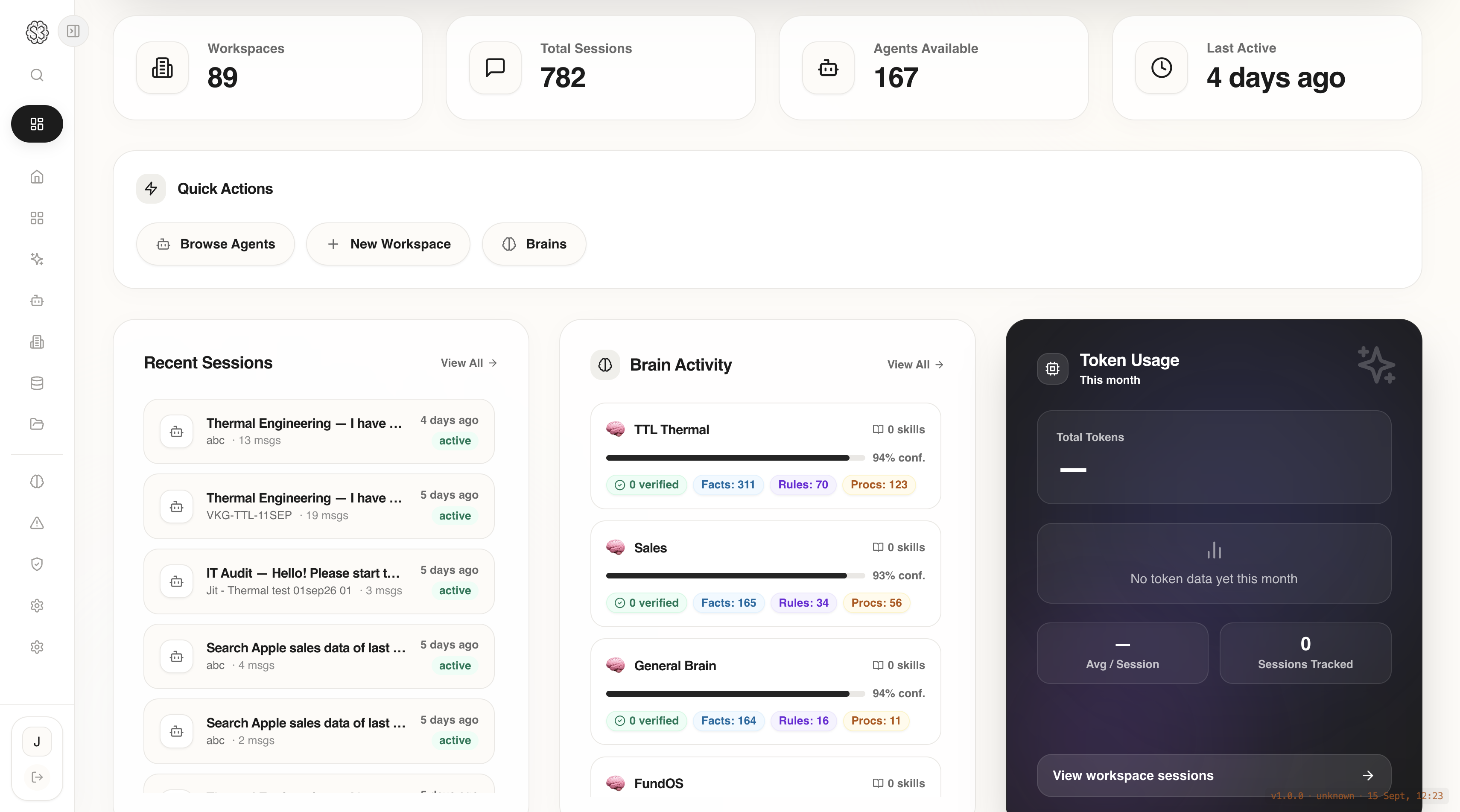
SuperBrains connects existing enterprise sources, resolves the context behind operational work, and makes that context available to agents across tasks, teams and workflows.
Connect
Existing systems and data in place: documents, drives, databases, SaaS applications, APIs and AI tools already in production. No migration or central rewrite is required.
Govern
Policy, scoping and audit apply to every action from the first deployment, before any output is produced.
Compound
The intelligence layer accumulates from operational work. Decisions, approvals, context and recurring patterns are captured as memory and reusable skills through Neuro Ports.
Operate
Every agent, copilot and model above the layer draws on the same accumulated context, so each starts from what the enterprise already knows and each call requires less of the model.
By Industry & Function
Built for regulated,
knowledge-intensive industries.
Manufacturing, financial services and telecommunications, where institutional expertise is the product and the cost of re-deriving it is recurring.
Manufacturing
- Engineering judgement
- Process rules
- Machine context
Design rationale, failure patterns and machine settings stop living in veteran operators’ heads and become something agents and engineers can query directly.
Core Functions
- R&D and Process Engineering Retrieve the design decision and its rationale without depending on the engineer who made it.
- Plant Operations Troubleshoot against the full record of prior failures, settings and remediations.
Finance & Banking
- Accuracy
- Auditability
- Regulatory currency
Regulatory updates, lending policy and portfolio context become a living knowledge base, so credit, compliance and relationship agents give consistent, auditable guidance.
Core Functions
- Credit and Lending Apply lending policy consistently across every case, with the reasoning recorded.
- Compliance and Risk Respond to regulatory enquiries with the governing memo, rule and date attached to the answer.
- Relationship and Portfolio Management Enter each client meeting with the commitments and context from the previous one already resolved.
Telecom
- Customer context
- Channel consistency
- Insight-led service
Customer history, offers and playbooks unify into one layer, so sales and service agents work from the same context across every channel instead of repeating each other.
Core Functions
- Customer Operations and Retention A single customer context, consistent across every channel.
Time to Production
From scope to production in
four to six weeks.
Enterprise AI adoption is commonly sequenced like a data platform programme: infrastructure first, with extended requirement-to-production cycles. In our experience across more than 50 enterprise deployments, that sequencing puts typical delivery at 18 to 24 weeks.
Because SuperBrains connects to systems already in place, that sequencing is not required.
Four to six weeks
Our target from scope to first production workload, against the 18 to 24 weeks typical in our delivery experience.
Days to first decision
Decisions supported by institutional context without waiting on a data programme.
Declining cost per answer
As the layer matures, a greater share of each request resolves before a model is called.
Case Studies
Client work across manufacturing,
financial services and telecommunications.
Each engagement below builds a Domain Brain inside an existing enterprise environment. Client names are available under NDA.

India
Manufacturing
R&D and process engineering
R&D Domain Brain and agents
Consolidates decades of engineering judgement into a Domain Brain, giving R&D teams and agents direct access to prior designs, test data and process knowledge.
- Impact
- Design rationale and test history answerable on demand, instead of depending on the engineer who was there.
- Governance
- Source-cited answers with full run tracing.
- Security
- Private cloud, customer tenancy.

Hong Kong
Finance & Banking
Wealth management
RM ops and portfolio management agents
Relationship managers and portfolio agents now draw on the same compounding memory of client context, mandates, and past decisions.
- Impact
- Client context carried between meetings and across handovers rather than rebuilt each time.
- Governance
- Mandate checks and approval trail on every recommendation.
- Security
- Regional data residency.

India
Finance & Banking
Venture capital
Digital workforce, research to reporting
A digital workforce of agents now carries deal research through onboarding and reporting, grounded in the firm's own frameworks and history.
- Impact
- Deal research, onboarding and reporting run as one traceable chain instead of three disconnected efforts.
- Governance
- Firm frameworks applied consistently, with human approval at each stage gate.
- Security
- Private cloud, customer tenancy.

Middle East
Telecom
Omnichannel sales and service
Insight-led sales, omnichannel agents
Omnichannel sales agents work from one compounding layer instead of siloed scripts, turning customer insight into consistent, on-brand conversations.
- Impact
- One customer context across channels, so a conversation continues rather than restarts.
- Governance
- On-brand and policy constraints enforced before an agent responds.
- Security
- In-region deployment.

India
Finance & Banking
NBFC lending and collections
Lending and collections use cases
Lending and collections agents apply consistent, auditable judgement across cases, drawing on a compounding layer instead of case-by-case guesswork.
- Impact
- The same policy applied to every case, with the reasoning attached to each decision.
- Governance
- Full audit record per case, thresholds set by the credit committee.
- Security
- Private cloud, customer tenancy.
The intelligence layer runs
where your obligations require.
Three deployment models, with the same enterprise controls applied to each.

SuperBrains Cloud
A fully managed deployment of the intelligence layer, with automatic scaling and controlled access.
Private Cloud (VPC)
Runs inside your own cloud environment with private networking and your own security standards.

On-Premises
Runs inside your own infrastructure, including fully air-gapped environments where a locally deployed open-source model runs on your own GPU hardware.
Next Step
Build an intelligence layer
your enterprise owns.
A 30-minute working session on your systems, your governance constraints and where the intelligence layer would sit in your architecture.